Reface, Repaint or Replace? A Clear Guide to Kitchen Cabinets
Cabinets take the largest share of most kitchen budgets. Three routes to a new look differ hugely in cost, disruption and what they can fix.

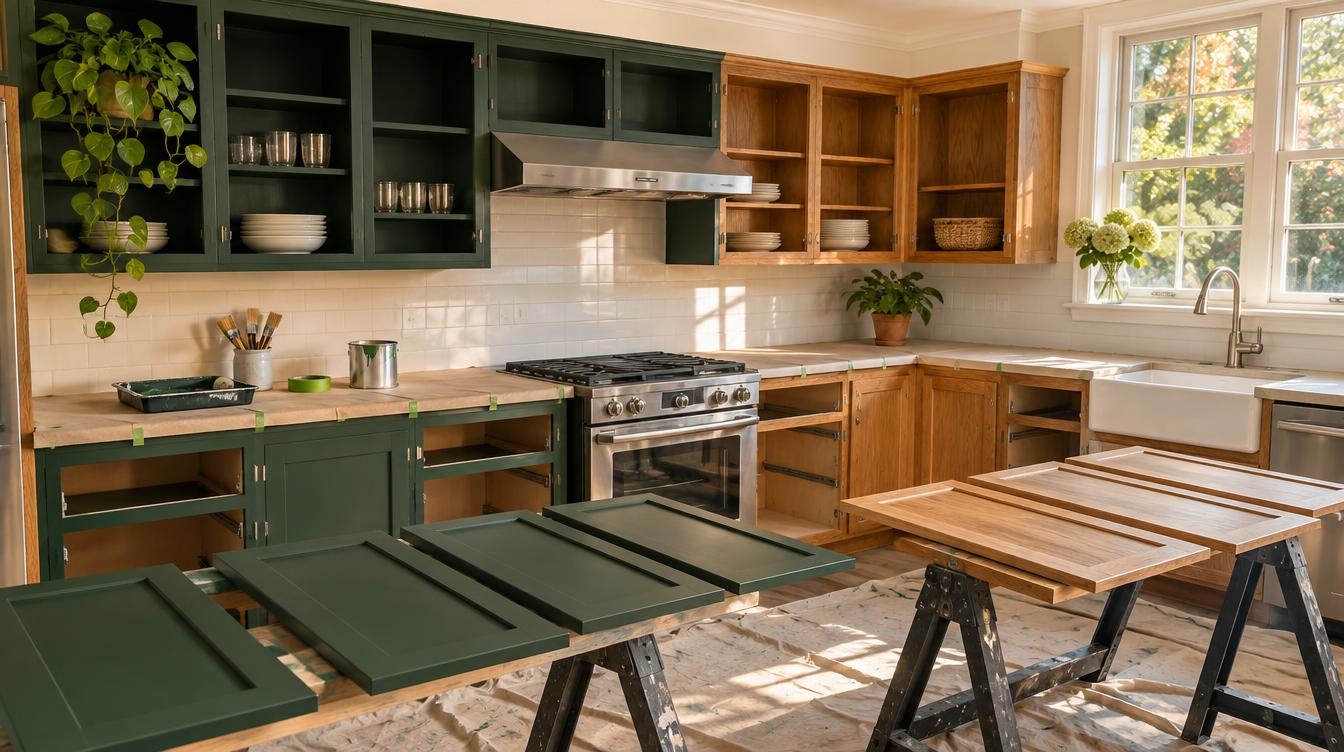
- If the cabinet boxes are solid and the layout works, painting or refacing gives a new kitchen for far less than replacing.
- Refacing replaces doors and drawer fronts and covers the boxes. It cannot fix a poor layout or water-damaged boxes.
- Good paint results depend on preparation and cure time, not on the paint alone.
In most kitchen remodels, cabinets are the largest single cost. They are also the element people most want to change, because they dominate what the room looks like.
There are three ways to change them, and they are not interchangeable. The right one depends on two things: the condition of the boxes behind the doors, and whether the layout of the kitchen actually works.
First, open a door and look inside
The visible parts of a cabinet, the doors and drawer fronts, are a small part of its structure. The box behind them is what matters.
Look at the sides and base under the sink first. That is where leaks show. If the panels are swollen, crumbling or stained black, those boxes need replacing whatever else you decide.
Check what the boxes are made of. Plywood and solid wood boxes are worth keeping. Thin particleboard that is sagging or pulling apart at the joints usually is not.
Then ask whether the layout works
Paint and new doors change how a kitchen looks. They do not change where anything is.
If you are happy with the position of the sink, the cooker and the fridge, and you have enough storage, you are a candidate for painting or refacing. If you want to move appliances, add an island or remove a wall, you are replacing.
New doors on a kitchen that does not work give you a prettier kitchen that still does not work.
Option one: repaint
Painting is the least expensive route and the most labour-intensive to do well. The paint itself is the easy part.
- Remove doors, drawer fronts and hardware, and label everything.
- Degrease thoroughly. Kitchen surfaces carry years of cooking residue.
- Sand to dull the old finish, then clean off the dust.
- Prime with a bonding primer suited to the surface.
- Apply two thin coats of cabinet-grade paint, sanding lightly between.
- Leave to cure, which can take days to weeks, before heavy use.
Skipping the degreasing or the primer is why painted cabinets chip. A sprayed finish, done by a professional, is smoother and tougher than a brushed one.
Option two: reface
Refacing keeps the boxes and replaces everything you see. New doors and drawer fronts are fitted, and the exposed faces of the boxes are covered with a matching veneer or laminate.
It is usually combined with new hinges, handles and often new drawer boxes with soft-close runners. From the outside, the result is hard to tell from new cabinets.
The work typically takes a few days and the kitchen stays usable throughout, since the worktops and plumbing are not disturbed.
Option three: replace
Replacement gives you a blank sheet. You can change the layout, add height, improve storage and fix whatever was wrong with the original design.
It is the most expensive and disruptive route. New worktops are almost always needed, plumbing and electrics are often moved, and the kitchen may be out of action for weeks.
| Route | Changes the look | Fixes layout | Fixes damaged boxes | Disruption |
|---|---|---|---|---|
| Repaint | Yes | No | No | Low to moderate |
| Reface | Yes, completely | No | No | Low |
| Replace | Yes | Yes | Yes | High |
What drives the price
For painting, the cost is labour. For refacing, it is the door material and the number of doors and drawers. For replacement, it is the cabinet grade plus everything that follows: worktops, plumbing, electrics, flooring and decorating.
That is why replacement quotes surprise people. The cabinets themselves may be half of the final figure.
Stock, semi-custom and custom
If you do replace, cabinets come in three broad grades. Stock cabinets are made in fixed sizes and are the least expensive. Semi-custom cabinets offer more sizes, finishes and options.
Custom cabinets are built to fit the room exactly and cost the most. In an awkward space they may be the only way to avoid wasted corners.
Upgrades that work with any route
Some of the most useful improvements have nothing to do with the doors.
- Soft-close hinges and drawer runners.
- Pull-out shelves in base cabinets.
- Drawer organisers and a pull-out bin.
- Under-cabinet lighting.
- New handles, which change the look for very little money.
Choosing who does the work
For painting, ask how the doors will be finished. The best results come from doors sprayed off-site in a controlled space.
For refacing, ask what the doors are made of, how the veneer is applied to the boxes and what warranty covers peeling.
For replacement, ask for a drawing, a full specification and a written schedule covering every trade.
A quick decision guide
Boxes sound, layout good, budget tight: repaint. Boxes sound, layout good, you want a completely new look: reface. Boxes failing, or layout wrong: replace.
Most kitchens fall clearly into one of the three once you have looked under the sink and asked yourself, honestly, whether you like where everything is.
Frequently asked questions
Is it cheaper to reface or replace kitchen cabinets?
Refacing is usually considerably cheaper, commonly quoted at roughly 40 to 50 percent less than new semi-custom cabinets, because the existing boxes stay in place. The saving shrinks if you add many new accessories or change the layout.
How long do painted cabinets last?
A properly prepared and cured finish can last many years. Expect to touch up chips around handles and lower edges over time. Factory-applied or sprayed finishes are generally more durable than brushed ones.
Can all cabinets be painted?
Solid wood and wood veneer take paint well. Laminate can be painted with the right bonding primer. Thermofoil, a vinyl film over fibreboard, is difficult to paint successfully, especially if it has started to peel, and is usually better refaced or replaced.